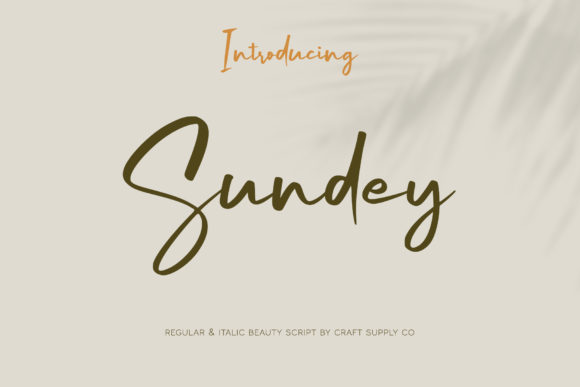
Sundey: A Delicate Script Handwritten Font for Editorial Elegance
As a publisher and editorial designer who crafts newsletters, digital magazines, and branded printables for lifestyle creators and independent educators, I rely on Sundey not just as another script font—but as a quiet yet decisive voice in my typographic toolkit. Sundey is a delicate, stylish and neat handwritten font, and its dainty vibe lands with intention: soft enough to feel personal, structured enough to hold visual authority. Unlike expressive brush scripts that compete for attention, Sundey functions as a refined display font—ideal for moments where tone matters more than volume.
Sundey for Wedding Invitations and Elegant Branding
When designing wedding guides, printable vow workbooks, or boutique stationery kits, Sundey delivers instant sophistication without sacrificing clarity. Its Script Handwritten rhythm flows with consistent spacing and graceful terminals—making it highly legible at 18–24pt in print and on high-res PDFs. I’ve used Sundey for cover titles of premium wedding ebooks and as the sole typeface for invitation suites paired with a light serif (like Adobe Garamond) for body text. Because Sundey avoids excessive flourishes, it scales beautifully across formats: from Instagram story headers to letterpress-printed save-the-dates. For brands targeting luxury, mindfulness, or slow-living audiences, this Fonts choice reinforces aesthetic cohesion and emotional resonance.
Sundey for Social Media Post Headers and Quote Graphics
In newsletter campaigns and content-led social media strategies, Sundey elevates quote graphics and article teasers without overwhelming the layout. As a Script Handwritten font, it adds warmth to otherwise minimalist templates—especially when layered over neutral photography or soft watercolor backgrounds. I use Sundey exclusively for pull quotes in blog posts and digital magazine features, setting them at 36–48pt with generous line height and subtle letter-spacing. On mobile, it remains crisp thanks to clean vector outlines—no pixelation, even in exported PNGs. For creators selling Canva templates or Notion planners, Sundey adds perceived value: readers associate its dainty precision with care, craftsmanship, and intentional design.
Sundey for Ebook Covers and Chapter Openers
Cover typography sets reader expectations before a single word is read—and Sundey excels here. Its delicate balance of personality and restraint makes it ideal for lifestyle, wellness, and creative nonfiction ebooks where authenticity and refinement coexist. I pair Sundey with a warm, readable serif (e.g., Merriweather or PT Serif) for subtitles and author names, preserving hierarchy while anchoring the composition. Inside the ebook, Sundey shines as a chapter opener font: set large, centered, and isolated on a full-bleed page. Because it’s a Script Handwritten font designed for display—not extended reading—it avoids fatigue while signaling transition and significance. Always test export settings: Sundey embeds cleanly in EPUB and PDF/A formats, and commercial licensing covers distribution in paid digital downloads.
Sundey for Newsletter Sign-Up Graphics and Lead Magnets
Your lead magnet is often the first tangible expression of your brand voice—and Sundey helps make that impression memorable. Whether it’s a “5-Minute Morning Ritual” checklist or a seasonal recipe printable, Sundey lends tactile charm to headlines and section dividers. As a Fonts asset, it performs reliably across platforms: renders correctly in Mailchimp drag-and-drop editors, converts cleanly in ConvertKit’s PDF generator, and maintains fidelity in Notion-linked templates. I avoid using Sundey for body copy (it’s not optimized for long-form screen reading), but for bold, short phrases—“Your Weekly Reset,” “Print & Reflect,” “Start Here”—its dainty elegance invites engagement without distraction.
Sundey for Printable Planners and Coaching Workbooks
For creators building paid digital products like habit trackers or self-paced coaching workbooks, typography builds trust. Sundey serves as an accent font that signals thoughtfulness—whether introducing weekly reflection prompts or framing affirmations in a guided journal. Its Script Handwritten quality feels human and approachable, which aligns perfectly with empathetic, client-centered brands. In multi-page PDFs, I apply Sundey consistently to section headers and decorative dividers, always pairing it with a highly legible sans serif (like Inter or Lato) for instructions and checkboxes. Licensing permits commercial use across unlimited client projects—so if you’re designing custom workbooks for therapy practices or yoga studios, Sundey supports scalable, on-brand delivery.
Sundey for Magazine Covers and Editorial Identity Systems
In editorial design, consistency is credibility. When developing a quarterly digital magazine or a themed content series, Sundey becomes part of the identity architecture—not just decoration. Its delicate structure allows it to function as both a title font and a unifying motif: repeated subtly in folios, pull-out borders, or watermark-style overlays. As a Script Handwritten font, it avoids the sterility of geometric sans serifs while retaining enough neutrality to complement diverse imagery—from documentary photography to illustrated infographics. For publishers building subscription-based content, Sundey reinforces premium positioning: it’s a Fonts investment that pays off in recognition, retention, and shareability.
Practical Notes for Editorial Use
- Sundey is best deployed for display purposes—titles, headings, quotes, and accents—not body copy or UI labels.
- Test readability on mobile: use minimum 20pt size for social graphics and ensure contrast meets WCAG AA standards.
- Pair with a highly legible serif (for print/ebook body) or neutral sans serif (for digital interfaces) to maintain hierarchy and flow.
- Verify included styles: most Script Handwritten fonts like Sundey offer standard OpenType features—ligatures, alternates, and multilingual support—essential for polished editorial output.
- Commercial license covers use in client deliverables, paid newsletters, templates, and digital product sales—no per-use fees or attribution required.